
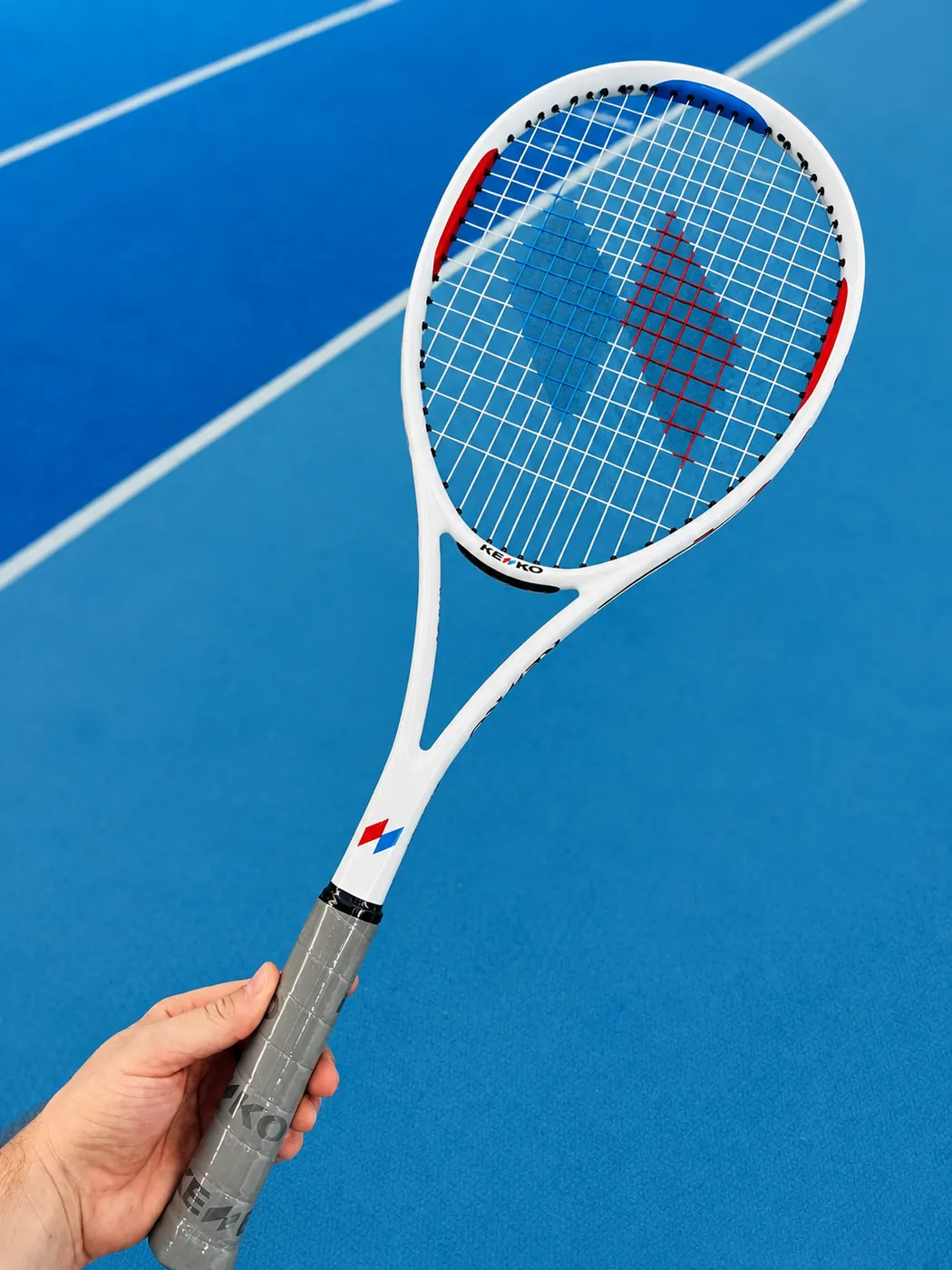
A soft tennis racket is a different piece of equipment from a tennis racket, even though they look similar from a distance. It is used to hit a soft rubber ball weighing 30 grams, so the whole construction is lighter, more flexible and strung at lower tension. Below is everything you need to know before buying your first racket, or your next one.
How a soft tennis racket differs from a tennis racket
Three things: weight, flexibility and stringing. A soft tennis racket usually weighs 200–250 grams, clearly less than a tennis racket. The frame is more flexible, because the soft ball stays on the strings longer anyway and a stiff frame adds nothing here. The strings are installed at much lower tension than in tennis, matched to the rubber ball.
You can try playing with a tennis racket, and nobody will bat an eye at your first practice. With regular play, however, the difference in weight and ball feel becomes significant, which is why the racket is the first purchase worth investing in.
Weight and balance
A lighter racket means a faster swing and a less tired arm; a heavier one gives stability on powerful shots. We recommend beginners start with lighter models: technique matters more than strength, and a light racket lets you learn it without fighting your equipment.
Balance works similarly. A racket with weight shifted towards the head hits harder from the back of the court, while one balanced towards the handle is more manoeuvrable at the net.
Front or back: a racket for your position on court
This is a soft tennis speciality that does not exist in tennis. Doubles here is played with a division of roles: one player operates at the net, the other from the back of the court. Manufacturers design separate racket series for this. Models for the net player are stiffer and stable on volleys; models for the baseline player have more flex and support long, spin-heavy strokes. There are also all-round series, and that is the best place to start until you know where on the court you feel better.
Head size
A bigger head means a bigger sweet spot and fewer consequences when you hit off-centre. For beginners and children, that is the right direction. Smaller heads give better control and precision, but they demand repeatable technique, so they only make sense once you train regularly.
Strings
Soft tennis strings are installed at lower tension than in tennis, and that is not a detail — it is one of the main equipment choices. Looser stringing gives more power and comfort; tighter stringing gives more control with a fast swing. We recommend beginners stay on the softer side of the range; players who play for precision move towards higher tension. If you buy a racket from us, we will suggest a stringing setup for your level of play — just mention it in your order.
What to choose when starting out
If you are just starting: a light all-round racket with a bigger head, strung on the softer side. That equipment will last you your first seasons, including after joining a club. If you already play regularly and know your position, choose a series for the front or back of the court and match the weight to your style of play.
In the rackets category you will find Nagase Kenko models with a description of who each one is for. And if you prefer to ask, write to us: we play competitively ourselves, and matching a racket to a specific person is a normal conversation for us, not a problem.
Choose a racket matched to your game
See rackets