
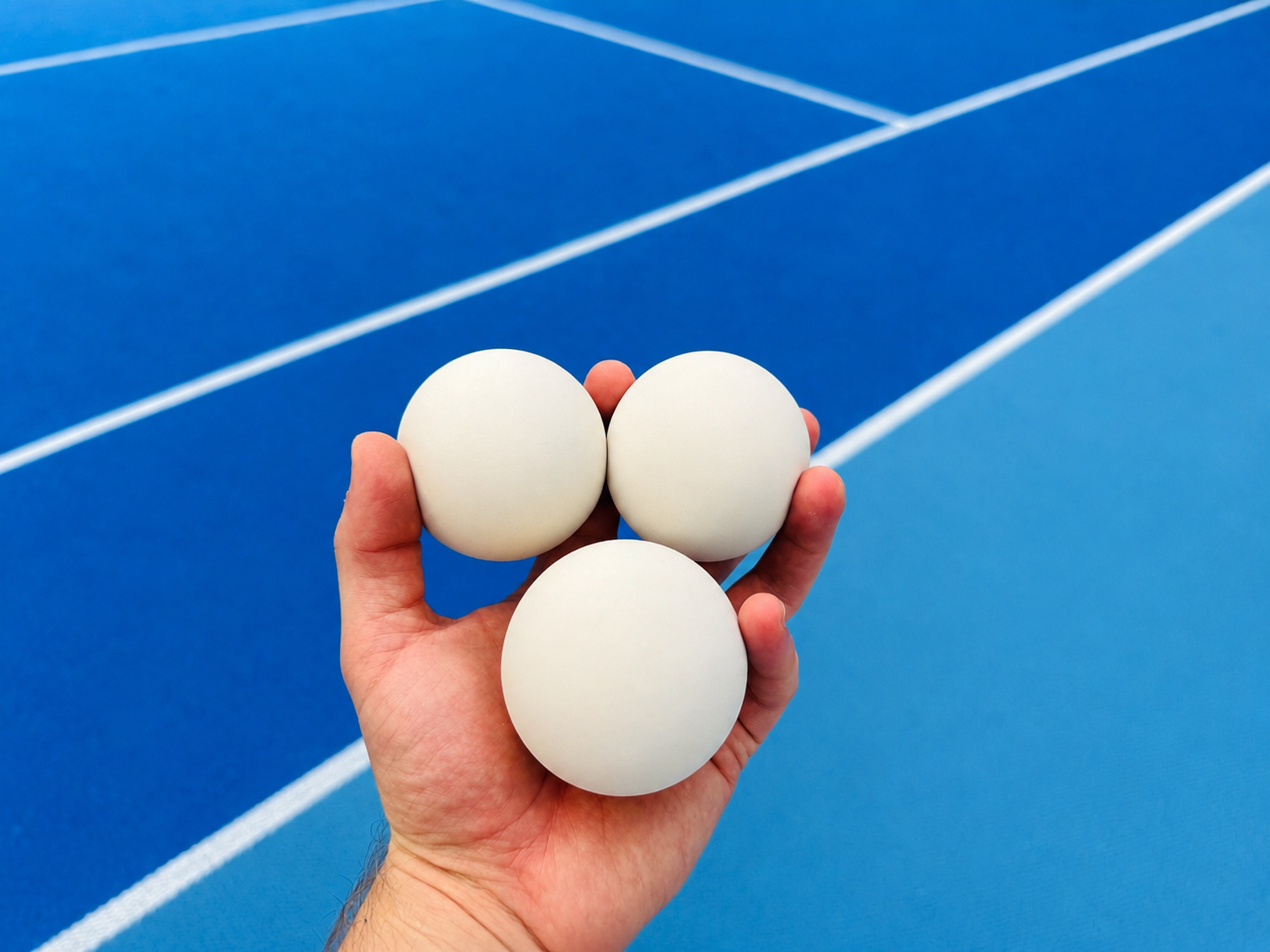
The ball is the heart of soft tennis. Rubber, hollow, filled with air, it weighs 30–31 grams with a diameter of 6.6 cm — the same as a tennis ball. Its condition determines how all the rest of your equipment plays, so it is worth knowing which to buy, how to inflate it and how to look after it.
Training or tournament
Tournament balls are Kenko's official match balls, the same ones used in competition. They have the most repeatable bounce and flight, so it is worth training with them before a tournament, so your practice feel matches your match feel.
Training balls are cheaper and they are what you play with every day: warm-ups, rallies, the serving basket. The price difference becomes significant when you buy balls by the dozen, and that is what life looks like in every club section.
A simple rule: learning the game and everyday club play means training balls; tournament preparation and matches mean tournament balls.
How many balls you need
For a game of two, three or four balls are enough. For a practice with serving drills and ball feeding you will want a basket — a dozen or more: nobody wants to interrupt a drill every two minutes to collect balls. Sections and academies count balls in the dozens, which is why we also sell them in bulk packs.
Pressure: the thing every beginner forgets
A soft tennis ball has a valve and you inflate it like an inner tube, with the thin needle of a pump. The rules define the bounce: a ball dropped from a height of 1.5 metres should bounce to 70–80 cm.
You do not need instruments to check this. Drop the ball from a metre and a half — roughly chin height — and watch whether it bounces to somewhere between your knees and hips. Bounces lower: pump it up. Higher, and the ball is hard as a rock: let some air out.
It is worth checking the pressure before every game. A soft ball flies slow and low, an over-inflated one rebounds nervously, and both ruin the feel you are learning.
Durability and storage
Rubber does not like frost or full sun. Store the balls at home, not in a car boot or a garage over winter, because the rubber hardens and loses its properties. A ball also slowly loses air between practices, which is why a pump is a mandatory part of your bag, not an accessory.
A worn-out ball does not go flat like a tennis ball — it loses the evenness of its bounce. When it starts bouncing crooked or will not hold pressure after inflating, it is time to replace it.
Which balls to buy
In our shop you will find original Nagase Kenko balls, training and tournament, in singles and bulk packs. It is worth adding a pump to your order if you do not have one yet.
Original Kenko balls, straight from Japan
See balls