
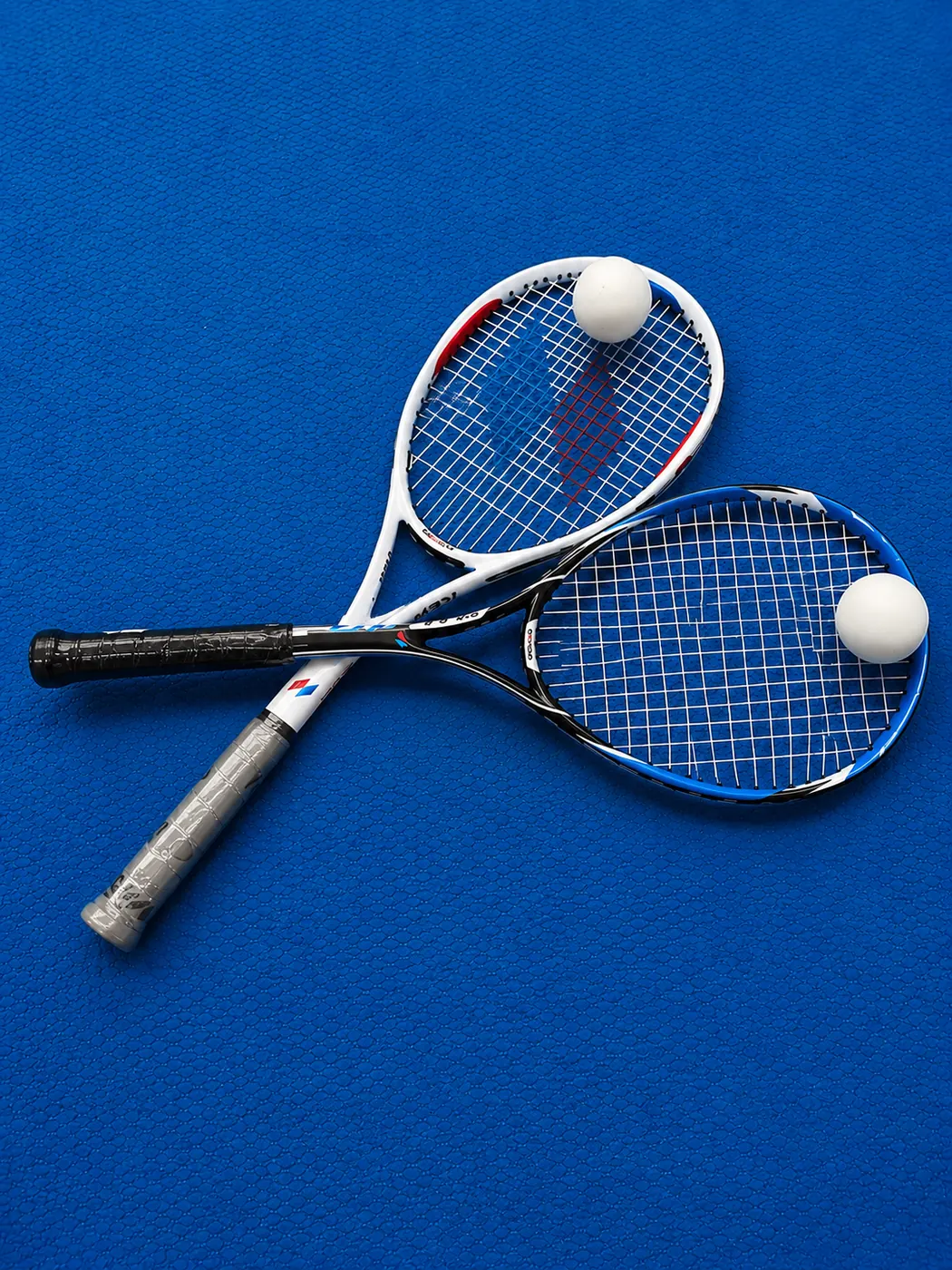
Soft tennis grew out of tennis in Japan in 1884, and from a distance it looks like a copy: the same court, similar rackets, familiar rallies. Up close it is a separate sport with its own ball, scoring and technique. Below are all the differences that matter when you switch in either direction.
The ball — the source of all the differences
A tennis ball is felt-covered and weighs about 57 grams. A soft tennis ball is rubber, hollow, and weighs 30–31 grams at the same diameter. Half the weight at full size means high air resistance: the ball travels slower, bounces lower and gives you more time to set up for the shot.
Almost everything else follows from this. Rallies last longer, the game is more tactical, and the wrist, elbow and shoulder work under less strain, because striking a light ball generates smaller shocks. That is why children, adults and seniors play soft tennis on equal terms.
Racket and strings
A soft tennis racket is lighter and more flexible than a tennis racket, and the strings are installed at much lower tension. You can try soft tennis with a tennis racket, but with regular play the difference in ball feel is too big to ignore. How to choose equipment is covered in our racket guide.
Same court, different net
The court dimensions are identical, so you can play soft tennis on any tennis court. The difference is the net: a tennis net dips to 91.4 cm in the middle, while in soft tennis the net hangs level at 1.07 m across its whole width. For recreational play it is enough to loosen the centre strap.
Scoring and match format
In soft tennis points are counted 1, 2, 3, 4 — without the tennis 15, 30, 40. A game is won by the side that first reaches four points, and at 3:3 play continues until a two-point lead.
A match is a single set: first to four games in singles, five in doubles. Instead of a tie-break, a final game is played to seven points. This makes matches shorter and more intense than tennis. Full scoring is covered in the rules of the game.
Technique: grip and serve
This is where the differences surprise tennis players the most. The western grip dominates in soft tennis, and the forehand and backhand are often played with the same side of the stringbed. You can serve overhead, but the cut underhand serve is a fully-fledged weapon used at tournament level too: a low-bouncing, spinning ball is hard to attack.
The second difference is the format of play. Tennis is in practice a singles sport, while soft tennis developed as a doubles sport, with roles split between the net player and the baseline player. Pair tactics are a discipline of knowledge in their own right.
Which sport for whom
It is not an either-or choice — many players combine both. Soft tennis has a lower barrier to entry: you will play your first rallies at your first practice, and your joints feel less strain, which players recovering from elbow or shoulder injuries especially appreciate. A tennis player will find a fresh tactical and technical challenge in it; a beginner, the shortest route to real play on a court.
See for yourself on your own court
See starter sets